



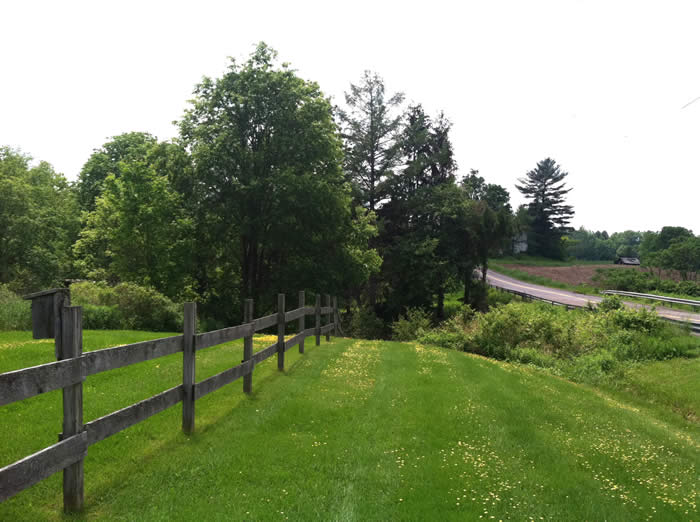
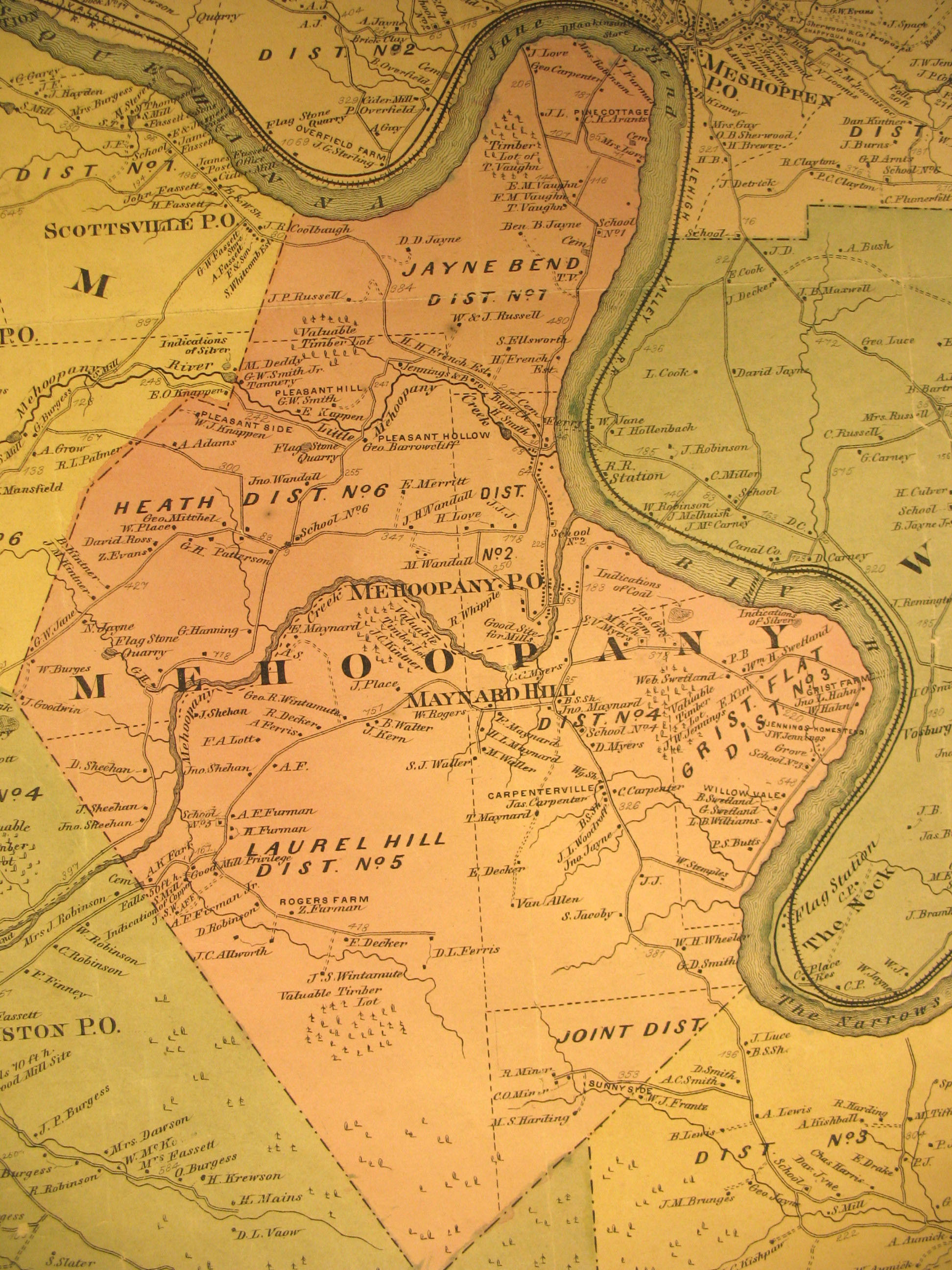
Emer, Parna and family first settled on the Isaac Morley farm, but in the Fall Isaac Morley was told, by revelation to the Prophet, to sell his land that he might devote himself better to the work of the Lord. (D&C 64:20) Their next home was sixty miles west in Brownhelm, Ohio, where they remained until the end of 1833, when they moved to Florence where Emer had purchased a farm.
Emer was ordained a high priest on 25 October 1831 by the Prophet and said on that occasion that "he was determined to be for God & none else & with his assistance to do his will." 1 Two days later he was appointed "scribe for Joseph Smith, while they are employed writing and copying the fullness of the scriptures.[PJSv1]"1 Conferences were held on the 11th and. 25-26th of October. On the 11th the brethren were instructed in the “ancient manner of conducting meetings”. A committee was suggested to instruct the various branches of the church in these methods and set things in order. With the church so new care had to be taken to see that things from member’s former ceremonies didn’t become a part of the meetings. When the conference adjourned two members had been named, David Whitmer and Reynolds Cahoon. At the next conference, held in Orange, Ohio, Simeon Carter, Orson Hyde, Hyrum Smith and Emer were chosen to complete the group. (DHC Vol.1 p.21) They were also asked to teach the principle of supporting those who gave full time to the church and particularly at this time to aid the Prophet Joseph Smith and Sidney Rigdon as they continued the work of translation and revision of the Bible. Rigdon served a portion of the next year in this work and other mission labors with Simeon Carter as called by revelation in Sec. 75:30 of the Doctrine and Covenants given on January 25, 1832.
During the conference at Orange the Prophet spoke to those attending: “We have assembled together to do the business of the Lord and it is through the great mercy of our God that we are spared to assemble together….. It is the privilege of every Elder to speak of the things of God and Jesus Christ and could we all come together with one heart and one mind in perfect faith the veil night as well be rent today as next week or any other time and if we will but cleanse ourselves and covenant before God to sere him it is our privilege to have an assurance that God will protect us at all times”. These words and others of the Prophet stirred the souls of many present and they spoke of their feeling for the Lord and His gospel. The minutes record Emer Harris as having said he was “determined to be for God and none else and with His help to do His will”. This pledge was one that Emer kept throughout his life. His faith and testimony remained firm through several periods of great difficulty and apostasy in the church.
Emer probably left after the birth of Alma (6 June, 1832). (It appears that the two men initially left together but that Simeon later joined Jared Carter while Emer then went with his brother Martin. Of this mission Emer penned, "Brother Martin is with me & has been the grater part of the time since we left Kirtland. We have traveled mutch & Preached mutch. Eighty two have been baptised and many more have believed. We find no end to the call for our labours."(16) In the summer of 1832 they “raised a branch of over 70 members at Springville, Susquehanna County, Pennsylvania. (17) This is 16 miles northeast of Mahoopany, PA where Emer has lived. The Evening and Morning Star reported that “I have just learned that brothers Martin and Emer have baptized about 100 persons at Chenango Point, New York [Windsor, NY], within a few weeks past"7
This letter dated May 7, 1833, written from Springville, PA gives a glimpse of his missionary service:
To: Mr. George James or Mrs. Parna Harris, Brownhelm, Lorain, Ohio. Dearly beloved Brethren: grace, mercy & pease be multiplied unto you that are in the Lord. And to all that are sanktified in Like faith. I have had a desire for a long time to write unto you & also to hear from you. But more partickalar to see you that I might be filled with your company & impart unto you by the word of mouth of my travels and Labors since I left you of which I can tell but little with pen & ink. Browther Martin is with me & has been the grater part of the time since we left Kirtland. We have traveled mutch & Preached mutch. Eighty two have been baptised and many more have believed. We find no end to the call for our labours And many miracles have been done in the Name of Jesus Christ & signs follow them that believe...(Writing too blured)...I have not been sick but the part of one day since I left you. I have not suffered by cold nor hunger, But have found many kind friends who have administered unto my necesetys. Altho we have found many apposers & bitter Enimyes, the Lord revward them according to their deed. The 24th of Last January Bro. Martin was taken a prisenor on a fals charge of standen went to prison a few days until we got Bail to answer to Cort the Last Monday in April, or we should probably have been to the Ohio before this time. But it is now put over until the next September tirm; therefore we shall take up our journey Westward ere long & go as the Lord shall direct until we arive in the Ohio. Whether the work be mutch or little on the way thither, we cannot tell, the will of the Lord be done, therefore, we cannot tell what time we may be expected there. The work of the Lord is prospering where ever we can hear. We are cretabbly informed that a man had wrote a letter from Canada to Ithaca where he lived two years ago, that he belonged to a Mormonite Church of 250 members in Canada...Dear Brethern of Brownhelm, Pray for me that I may have my mouth open to speak sutch things as I aught to speak & that I may have a safe return to you in the Lords one (own) due time And I will t ry to pray for you. Truly it is a day of sacrefising & the tithing of his people but they that are tithed shall not be burned. Prais the Lord for his goodness. Continue in the faith unto the end...(writing too blurred)...Praise Him ye saints & give him all the glory. And we will praise him again when we pass over masoury(Missouri) Dear Brethern, I will send you a few lines composed by a sister of the Church of (Jesus) Christ a day or two after Bro. Martin was sent to jail on the occasion of his imprisenment. To all the Brothers & Sisters in the Lord At Brownhelm, Lorain Co., Ohio, Springville, May 7th 1833 So I remain your unworthy Brother in the Lord (Signed) Emer Harris (18)
Perhaps the following incident happened while Emer was filling this mission. Brigham Young wrote: “Every person who is well acquainted with the history of this Church knows that at the commencement of it the persecutions commenced, and they continued to increase until the death of the Prophet. Forty seven times he was arraigned....He was never found guilty, but once. I have been told by Patriarch Emer Harris that on a certain occasion he was brought before a magistrate in the State of flew York, and charged with having cast out devils; the magistrate, after hearing the witnesses decided that he was guilty, but as the statutes of New York did not provide a punishment for casting out devils, he was acquitted. (19)
The following is a copy of the letter written from Springville, Pennsylvania, to Emer's wife, Parna:
Dear Wife, my best respects to you & the children and may the Lord bless you all. I have longd to hear from you and to know how you got along both timerally & spiritually but more to see you & our little son. Parna, I have not received any letter from you. When I wrote to Kirtland & directed them to write to you to let you know how did & where I was & also to inform you that I woud write to you often. I have been to Windham (Township) I have been also to the head of Towanda Creek (Canton, PA) , have seen all your folks But as Tacy said she would write to you I shall not say any more concerning them now. I will now speak of our old neighbours they are generally full of hardness & unbelief. Hatfield is firm in the faith, his wife has been Baptised. Jonthan Farr, Lenard Lott and Eligah Fossett Sr. are dead & Taylor has had a child drowned. Lydia Farr is married to Jessey Clapp they have a child 5 or 6 months old. My farm is sold for 550 Dollers I was to have one half of the pay this spring the remainder next but I shall not be able [to] get any mony at all on the accout of the dry wether so that their is no runing of Lumber to get mony, the dry wether still continues. Parna, I must now conclude my letter by sending you a few lines composed by a sister of the Church for you.
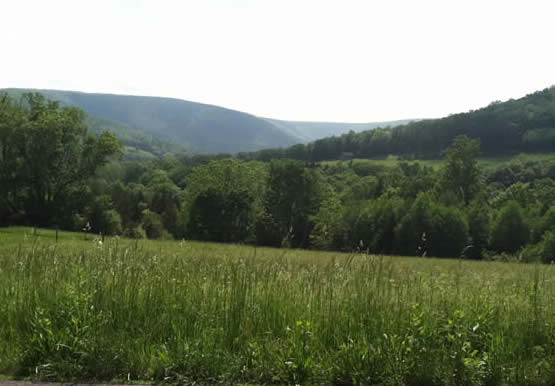
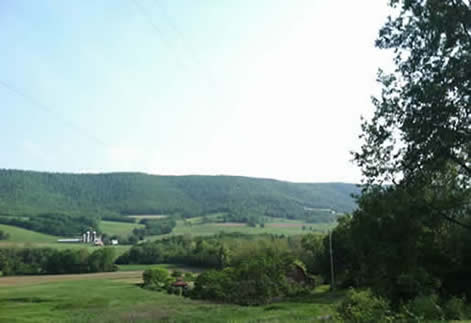
View of Leroy Township near Canton, PA area where Parna Chappel lived prior to her marriage to Emer in 1826
1. Now come Dear handmaid of the Lord
Come listen to the gospel word
The Lord commands your Husband go
And says the gospel trumpet blow
2. Now he is cald to leave his home
Ore braud creation for to rome
An all the Nations for to call
And Preach the blessed news to all
3. The Lord stand by you in your fears
And he will wipe your falling tears
And teach you all his holy will
That He's the blessed Savior still
4. And he will guide you with his hand
And bring you to join Zions land
And if on earth you no more meet
Its there your joy will be compleat
5. Then O Dear Sister do not faint
The Lord will hear your souls complaint
O pray to him from day to day
And then your faith will not decay
6. He lives to hear your feable cryes
He lives to wipe your weeping Eyes
Then prais him in the highest strains
He is the King of Kings who reigns.
Farewell Dear Wife till we shall meet again, give my respects to all inquiring friends, so I remain your affectionate Husband
[Signed] Emer Harris. 16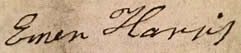
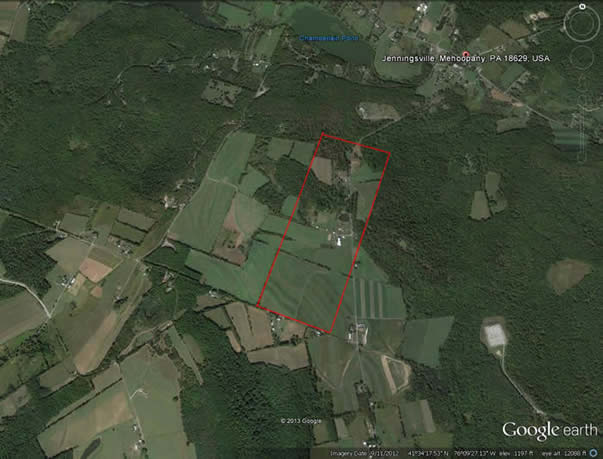
Boundaries showing Emer's 150 acre farm sold to for $550 to Cyrus Clapp in 1833 2 years after moving to Kirtland. 30
Emer's son Martin recorded in his Journal “Father started on a mission East and was gone a year, wanting eleven days”. By midsummer 1833 Emer had returned from his mission, having preached the gospel and, to the joy of his family, having sold his land in Pennsylvania for $550. The money was used to purchase a farm in Florence township, Ohio. Charles was born 2 July 1934. The family had moved several times since leaving their farm in Pennsylvania. They spent two and a half years on this farm but his effort had not met with total success due to late frost in 1834, but in 1835 they had “a middling crop of corn, a good crop of potatoes and apples”. (20) In the Spring of 1836 they gave up the farm and were moved by Moses Daley (his son Moses Judson Daley later married Emer’s daughter Harriet) to a farm on Chardon Road. Emer’s brother Martin also had a farm in this area. The weather worked against the saints farming efforts for another year as Martin H. indicates a cold wet summer in 1836 and “poor crops” in 1837, with no special reason given.
In 1835 , when not working on the farm, Emer labored as a carpenter and a joiner on the Kirtland Temple. He created the window sash in the temple and other intricate details within the sacred building. In spring of 1836 moved to farm three miles from Kirtland.
In November of 1835 Emer’s father Nathan died at Menton Ohio, while living with Preserved, younger brother of Emer and Martin. On November 18, 1835 Joseph Smith wrote: At home in the forenoon, until about eleven o’clock. I then went to Preserved Harris’ to preach his father’s funeral sermon, by the request of his family. I preached on the subject of the resurrection. The congregation were very attentive. My wife, my mother, and my scribe, accompanied me to the funeral. Pleasant outing, but cool and cloudy on our return. (DHC Vol.2 p.3l7) In six months Preserved was disfellowshipped for ‘lack of benevolence and want of charity towards the church.” (Doc. His. Vol 2 p.445) These charges were brought by Joseph Smith. Donations were frequently asked for since so many arrived in Kirtland without the means to care for themselves. During this same period of time Emer’s name appears on a list of those donating money to the Prophet. His donation of $1.00 doesn’t seem like much until comments in various journals show a day’s wages to be .75 to $1.00.
These were glorious spiritual days in Kirtland and troubled temporal ones. The temple was completed and wonderful visions were manifested to the Prophet and others and some lesser ordinances performed. The Doctrine and Covenants was prepared and approved. More scriptures through revelations were coming forth, bringing more enlightenment to the saints. However, $13,000 was still owed on the temple and few paying jobs were available to the members. Their small businesses were running on credit. The Prophet proposed a bank, of sorts, which would issue notes based on land value and a mortgage system. The Spring of 1837 was a period of financial turmoil in the whole country. Land speculation was followed by a serious depression. Within one month 800 banks failed, and so, the Kirtland Safety Society fell also. A spirit of speculation had caught the saints in its grip. Heber C. Kimball, returning from a mission to the East was shocked at the greed, faultfinding, and dissension among the saints in Kirtland. City lots selling a few months before for $150 were now going for from $500 to $1000. Almost everyone seemed determined to get rich. Nearly every quorum of the priesthood was infested with this corrupting spirit. Many who had been humble and faithful in the performance of duty in the church had become haughty in spirit and lifted up in pride. “As the fruits of this spirit,” commented Joseph Smith, “evil surmisings, fault-finding, disunion, dissension, and apostasy followed in quick succession, and it seemed as though all the powers of earth and hell were combining their influence in an especial manner to overthrow the Church at once, and make a final end”. (Joseph Smith and the Restoration, Barrett p. 341)
Many became disaffected toward the church, and the Prophet, at this time because the bank had failed. Joseph had counseled against the greed and speculation which had become an obsession with the majority of the saints. The corrupt spirit he feared caused even some members of the Twelve and the witnesses to the Book of Mormon to seek to have him removed as Prophet, and David Whitmer named in his place. The threat from outside by those who wanted the Mormons to leave was not nearly as dangerous as that from within. Emer’s brother Nathan, was among those who turned against Joseph and in December he was excommunicated by the High Council.
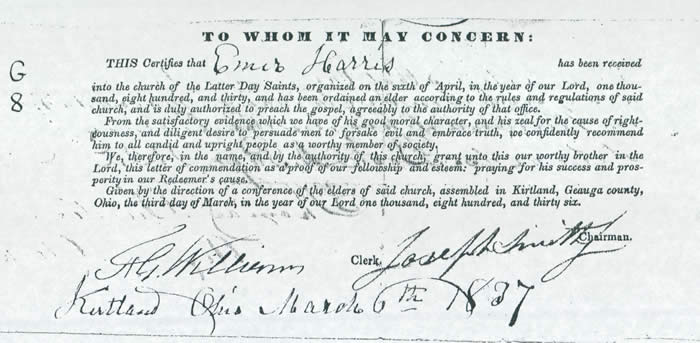
Letter of commendation and proof of Fellowship signed by Joseph Smith and F.G. Williams in Kirtland, OH, March 6, 1837
Both his brothers had become disaffected from the Church, in Kirtland. But Emer, with his faith intact, left Kirtland in the summer of 1838 to return to Pennsylvania to collect the money owed him for the farm he left there in 1831. The members of the church had been Instructed to move to upper Missouri where other saints had been living in peace for several years. A number of them formed a group called Kirtland Camp to aid one another in the move, but Emer probably felt the need to get his business settled in Pennsylvania before he moved still another 900 miles away. Former members of the church were persecuting the saints in much the same manner that non-members had done in the past. When Emer returned to the family in July records show he was afflicted with rheumatism in his hip. McLellin visited him in Florence, Ohio.
They were apparently unaware that all was no longer well with those who had been living in relative calm in Caldwell and Daviess counties since 1836. In July a celebration had been held and Sidney Rigdon had given an address that had been published and angered many citizens of the state. He had warned that the saints would no longer be trampled on and that mobs who came upon them could expect them to stand for their rights until death, This, along with the influx of members from Kirtland during the summer caused another incident at an election held at Gallatin on August 6, 1838. The settlers were concerned that the Mormons would soon control the area and so decided not to allow them to vote. A small fight erupted and the settlers group left to get weapons. The Mormons were persuaded to leave, but It was the beginning of a number of incidents that increased in severity and paranoia on the part of the Missourians until it resulted in such happenings as the Haun’s Mill Massacre.
With a span of horses and light wagon he “bought another horse and two-horse wagon from Uncle Preserved and started for Missouri on the fifth day of September”. 1838 (MHH) Emer, Parna and the children arrived in Far West, Missouri, about 12 October 1838 arriving at Uncle Ezekiel Kellogg’s (husband of Emer’s sister, Naomi) in Caldwell County. The atmosphere was tense. They may not have even unloaded the wagons, for they left within the week to find a place in Illinois.
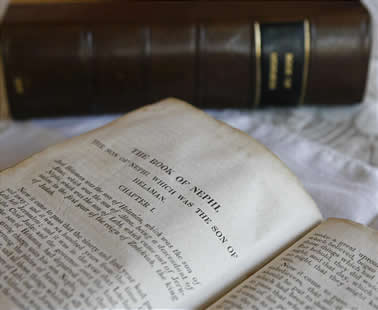
They had journeyed nearly nine hundred miles, arriving the same month Governor Lilburn Boggs issued the Extermination Order and the mob atmosphere, supported by Gov. Boggs, made it necessary for them to move again. Forced to leave 17 October 1838. All weapons were to be surrendered and all Mormon scripture found was being burned. Before leaving for Illinois Emer made preparations to carry his cherished Book of Mormon. Taking a wooden chest, he shortened it on one end, packed his book and others in tight1y and added a new lining of fuller’s cloth. The chest was filled with clothing. The keyhole had become off-centered by cutting one end off, but he hoped no one would notice. Along the way Emer walked off the trail carrying his gun so he would not have to surrender this source of food and protection. Parna and the family traveled with the wagons. They were stopped, questioned and searched by troops who were more like a mob in their zeal. Parna, who admitted proudly to being a “Mormon”, told them to search. “You have driven around so much we have nothing but rags,” she said. Even the interior of the chest came under inspection, but nothing was found and they were allowed to pass on.
The new destination for the saints was in Illinois. Young Martin recorded that they “arrived on the bank of the Mississippi River about the 12th of November, having traveled the whole distance through rain, snow and mud”. Due to floating ice they remained there until the twenty-second before they could cross the river. About the first of December shelter for the winter was found when they moved into a hone owned by John Gault near “Rock Creek, eight mile’s north of Quincy”. (MHH Jour) In the Spring they built a house on the farm owned by Cephas Stow and both Emer and young Martin worked on land they rented from him.
In 1839, while living in Quincy, Emer was ill but no indication is given - as to what the nature of the sickness was, except he did not “fully recover for a year”. Malaria was troubling a number of the members at this time.
The year 1840 found Emer looking for a new place. He bought 40 acres, three miles northeast of Nauvoo and in the Fall they built a home there. It was early the next Spring when they moved in, “fenced about half the land and broke up and planted about ten acres”.
The cornerstone of the Nauvoo Temple was laid on the sixth of April, 1841. Emer worked on the construction as a carpenter. He worked his land and when needed Martin would help him, but he was twenty-one now and was often on his own, traveling around working for others in farming, timber and mining. Dennison wan 16, Joseph 11, Alma 9 and Charles 7. These boys were all old enough to aid in the work. Emer was sixty.
The record of the family is found in the Nauvoo Second Ward. It lists Emer & Parna Harris, Jeremiah, Martin, Harriet, Dennison, Fanny, Joseph, Alma and Charles. Jeremiah is given in the family list, but his identification is unknown.
The near completion of the Nauvoo temple gave a number of the saints an opportunity to receive their endowment. On January 30, 1846 Emer and Parna were among those thus blessed. Dennison Lott Harris was endowed 7 Feb 1846 and Harriet Fox Harris Daley and her husband Moses Judson Daley 20 Jan 1846.
He was a member of Nauvoo Legion. During the years in Nauvoo, Emer decided to accept the principle of polygamy and he married Polly Chamberlain, daughter of Solomon Chamberlain, 11 January 1844. On December 24, 1845 their only child Rebecca was born. Polly was also a member of the Nauvoo Second Ward.
During the years in Nauvoo the church continued to be troubled with many of the problems faced before. Both Martin H. and Dennison did what they could to protect the Prophet from his enemies within and without. Martin served in the Nauvoo Legion and told of guarding the Prophet’s home at night. Dennison and a friend became aware of a plot against the Prophet by some members of the church. They went to Emer, who advised them to see Joseph Smith about it. He asked them to act as his spies, which they did at several meetings. Another time Martin cane upon the Prophet in the woods where he had gone to be safe from those who were seeking to harm him. Joseph requested that Martin keep his location secret and Martin gave his word, telling the Prophet “You will know by what happens that I have kept my word.’ The love and protection rendered the Prophet by many was, of course, to no avail and he was killed by his enemies. Again the faith and testimony of the members was tried as a new Prophet took his place as head of the church. In time as Brigham Young took over some chose to go their own way, but Emer and his family followed the Lord’s new prophet.
In the Spring of 1846 Emer went upstate to Galena to visit his son Martin He told him the Mormons were leaving Nauvoo. Sometime during the next year he left for the Kanesville, IA area for Martin recorded visiting “my folks” there in the summer of l847.
Emer and Parna had each received patriarchal blessings in 1845, given by Patriarch John Smith, the Prophet’s uncle. Parna’s was given in the Fall not long before Emer's 2nd wife, Polly’s child Rebecca was to be born. There seems to be some sorrow or problem in her life that Patriarch Smith is aware of for it is a healing blessing as well. Parna was known as a woman of much courage. Apostle Moses Thatcher said of her “She was as brave as a Lion”. Several problems come to mind when considering her blessing. Her family, the Chapel’s, had not joined the church though Emer had visited and preached to them. Perhaps the hardships of the preceding fifteen years had broken her health and her task was far from over. She had buried her daughter, but she still had sons age 12,14 and 16 and the long journey west was ahead. Joseph and Brigham had both seen the place in vision. Perhaps Emer’s taking another wife was her struggle.
PARNA’S BLESSING
October 21st 1845
A Blessing by John Smith, Patriarch, upon the head of Parna Harris daughter of Isaac and Tamison Chapel, born Nov. 12, 1789, Berkshire Co. Massachusetts.
Sister Parna, I lay my hands upon thy head in the name of Jesus Christ and by the authority of the Priesthood I place a father’s blessing upon thee. I also rebuke the spirit of infirmity that troubles thee and every foul and wicked spirit, in the name of Jesus Christ and ask my Father in Heaven in the name of his son to seal the rebuke in the heavens as being done by his own commandment, that she may be made perfectly whole in mind and all her members, that her body may be cleansed from every disease; reorganized and set in order that thou mayest be restored to soundness as in the days of thy youth, that thou mayest be made useful in thy family and in the church and kingdom of Jesus Christ. Now sister be comforted, give no heed to the vain and foolish reports which often trouble the minds of the daughters of Israel, but let your mind he stayed upon the blessings and promise of the God of Jacob and make his arm your trust, for thou shalt be blest and thy family shall be blest. Thou shalt see the day when thou shalt dwell with them in friendship and peace.. This is thy blessing sister, inasmuch as thou wilt give heed to the counsel of the servants of the Lord and lean upon His arm and not a word of it shall fail. Even so. Amen.
EMER’S BLESSING
No. 908
July 19th. 1848
A Blessing by John Smith, Patriarch, upon the head of Emer Harris, son of Nathan & Rhoda, born May 29th, 1781, Washington Co, New York.
Bro. Emer in the name of Jesus of Nazareth, I lay my hands upon thy head, by the authority vested in me to bless the fatherless. I place upon thee all the blessings of Abraham, Isaac & Jacob. Thou art of the house of Jacob & an heir to the priesthood & a right to the blessings which were sealed upon his sons, which has been handed down through the lineage of the fathers. The same is now sealed upon thee to continue through all the generations of thy posterity & because of the integrity of thy heart. Thou hast not fainted in times of dissentions & persecution, when every evil thing has spoken against the church of the living God, thou hast endured in faith & the Lord is well pleased with thee & he will heap a multiplicity of blessings upon thy head. Thou art called to be a counselor in the house of Israel & thou shalt have wisdom given unto thee to enable thee to magnify thine office, acceptably before the Lord. Thy testimony shall have great weight among all people because of thy candor & the simplicity of thy manner of communicating it, & because thou art alone as if were in thy father’s house, thy posterity shall be greatly blessed. They shall stand on Mt Zion, clothed with all the authority of the priesthood & thou shalt be able to control the hearts of thy friends & save them & reign over them, notwithstanding they think themselves greater than thee. Thou shalt possess plenty of the fruits of the earth, the riches of eternity shall be given unto thee & thou shalt inherit eternal life, in as much as you abide in the truth, these words shall not fail, even so amen.
Patriarchal Line of Authority: Joseph Smith Sr. was ordained as a patriarch, by Joseph Smith Jr. 18 Dec 1833, Hyrum Smith was ordained as a patriarch, by Joseph Smith Jr. 28 Jan 1841, John Smith was ordained as a patriarch, by Joseph Smith Jr. 10 Jan 1844, John was ordained as the presiding patriarch, by Brigham Young and Heber C. Kimball, 1 Jan 1849, Emer Harris was ordained a patriarch in Aug 1853
Emer and Polly’s firstborn and only child from their apparant civil marriage earlier in 1845 was born 24 December 1845. Then in 1848, Polly and Emer were sealed by President Brigham Young in Willard Richards’s office at Winter Quarters. The ceremony was performed January II at 7:00 p.m. with Heber C. Kimball and Newell K. Whitney as witnesses.
In the Summer of 1849, Emer suffered the loss of Polly, who died at Kanesville, Iowa in June, leaving Emer once more with a small motherless child. Rebecca was just three and a half. Emer was sixty eight! He gave the child to his sister Naomi and her husband Ezekiel Kellogg to care for. Rebecca traveled with them as a young 4+ year old to Salt Lake in 1850.
In 1850, his son Martin H. began a journey west by traveling from Quincy where he had been visiting to St. Louis to acquire goods, and on to St. Joseph where he bought a wagon and yoke of six year old cattle, a yoke of four year old cattle and a “further fit out for the plains’. He arrived in Kanesville about the 14th of May and stayed with his father Emer for a month preparing his teams and acquiring two cows and other things to be ready to go. He wrote, “Started from Father’s for the Valley on the 14th of June in company with Mother (Parna) and Alma, Joseph having started already with Uncle Ezekiel [Kellogg], leaving [Emer with Dennison and Charles to come when they should get ready”. Emer, Charles and Dennison did not come to Utah until 1852. Rebecca’s history says her grandfather Solomon Chamberlain came with them also. He was a trail scout known as “Old Buckskin” and had made the first trip west with the vangard company of Brigham Young in 1847, but had returned east. Parna settled in Ogden where she died in 1857. It is not known the relationship of Emer with Parna in those 5 years both lived in Utah before her death.
In 14 February 1851 in Iowa, Emer married Martha Allen (polygamist wife). She was another widow with young children.
When Emer arrived in Utah in 1852 he chose to live with Martha in the Provo area along with Dennison and later Harriet and her husband M. Judson Daley, who came in 1862. At first they lived in a dugout with no fireplace and no windows, sleeping in the wagon. In the winter they shared a fire with other settlers. Conditions ere very hard and through an accident their wagon was burned. Neighbors helped build a small cabin and shared bedding with them.
Later Emer is found in the Provo third ward. In 1853 he was ordained a Patriarch and in August of 1855 he was honored as one of the oldest men present at the ground breaking for the Provo “meetinghouse”.
"I am instructed by President James C. Snow that according to previous appointment a large concourse of people gathered on the land set apart for the Provo meeting house at 5 o’clock p.m. to consecrate the ground for said house. After forming a hollow square at the place located for the southeast corner of the building the choir sang an appropriate hymn. Pres. Snow made some very appropriate remarks In relation to the building and the propriety of carrying out the counsels of the Presidency of this church and the necessity of being united in carrying the same into effect. The president then called upon the whole assembly to kneel with him and join in offering the dedicatory prayer and the three eldest men at the ground proceeded to break the ground at the southeast corner. Samuel Vincent at 77 years of age, Patriarch Emer Harris, 72 years of age, James A. Smith 69...."
27 August l855
Deseret News 5:224
A few days following, David Pettigrew, President of the High Priest Quorum for the church visited in Provo to organize the High Priests there as he had done in other places during the preceding two months. He wrote: “September 1st, returned to Provo, and was well received. Sunday, 2d, held meeting at 10 a.m. when good attention and a good spirit were manifested. In the evening called the High Priests together in the Seminary; had a very good time, and organized them by appointing Emer Harris president over 50 High Priests in that place. In all places visited on this trip, I lifted up my voice in solemn warning to the High Priests and Elders in Israel to be up and doing, to do their duty in this the last, the eleventh hour, that they may earn their penny.
A record of sealings indicates that on September 10, 1855 at 4:l5 p.m. Martha Allen was sealed to Emer Harris in Provo by Geo. A. Smith and witnessed by Wm. Nuttal Jr. & Sr. She was a widow with a family and for a time Rebecca lived with them, but she was unhappy with her treatment and ran away to live with a half brother. This was probably Dennison, as he lived in Alpine.
For a period of several months in the Spring and summer of 1558 all of Emer’s Utah family was in the Provo area due to the threat of Johnson’s Army. The Amy was camped east of the valley during the winter and the saints had been instructed to move south. If necessary those men who stayed behind were to burn the settlements rather than have the army take them. Martin tells of planting his crops in Weber County and making several trips to Springville to build a cabin and plant a garden for his family. Alma’s wife, Sarah, gave birth to Lafayette in Farmington on the way south on May 2, 1858. She had a brother living there so perhaps that was where she made her temporary stop. Both Charles and Alma were to participate in the defense of the Northern area after settling their families south. One wonders what kind of odd little places were left when the crisis ended a few months later, with the army passing peacefully through, and the saints moved home again
For the next several years we can only assume that Emer was found in Provo doing his duty. Many of the records there were burned. His fifth wife, Martha, did not live many years after their marriage in 1855, for in November Martin recorded that his father had left Provo and come north. Parna had died in 1857, but Martin, Alma, Joseph and Charles were all living in the same general area in 1859. For the next three years Emer visited around with his children and continued to act in the capacity of a Patriarch.
On the 19th of October 1862 the Journal History of the Church records that “Emer Harris, Box Elder County, Patriarch, and ________Harris, son of Emer, Box Elder are called on the Cotton Mission by Heber C. Kimball at a meeting held at 6:30 p.m. in the tabernacle. The first callings to the Cotton Mission had been issued the previous year, but many of those called did not respond. The call, as printed, had no name for Emer’s son, but it was for Charles. He and Dennison, with Emer, left Ogden less than a month later on Nov. 12, 1862, for Southern Utah. Some have said Emer accompanied Charles and Dennison when they went, But Emer’s was an actual call to go, and at age 81 he did! Five years were spent south in the Virgin and St. George area. Dennison and Charles never did return to Northern Utah, but made their homes in various central Utah towns. Dennison served as Bishop in Monroe for several years.
In 1867 he returned to northern Utah, returning from his mission Emer again made his home in Provo. He may have lived for a short time with his daughter Harriet Daley.
From Martin H. Harris’s Journal August 1867:
Aug 21 Getting ready to go to Springville and Provo about 100 miles South to get Father and bring him back with me.
22 Started and traveled to Kaysville.
23 Traveled seven miles beyond Salt Lake City.
24 Reached Provo, found Father well.
25 Sunday: At meeting Pres. Young and others preached. In the evening started with Cousin Sophia for Springville. Arrived after dark and stayed with Judson Daley.
27 Started home. Traveled 20 miles with Father and Sister Harriet who is to act as proxy for her and my Mother when Father is getting his Second endowments.
28 Arrived at Salt Lake City and put up with Aunt Caroline.
29 Father got his endowments when we started for home and stayed all night at Oliver Robinson’s Farm.
30 Arrived safe home with Father.
Until December 31 1866, when they were resumed at the Endowment House, these special ordinances had not been given since the Saints left Nauvoo twenty years earlier.
For the next two years Emer visited with his children. In September of 1869 he was taken to Logan by Joseph to visit Alma and Sarah. He died there on November 28, 1869 and was buried in the Logan Cemetery.
At his death he had been a member of the church for 39 years and had been as he had determined to be in 1831....”for God, and none else”. Enduring the persecutions, the moving about, the diseases and dangers that were the lot of the early members he served as a missionary, helped build two temples, traveled nearly 900 miles from Kirtland to Missouri when he was 57, only to be immediately driven out and forced to go to Quincy in the snow and mud. He crossed the Plains when he was 71, became a Patriarch at 72, went on the Cotton Mission at 81. His five wives all preceded him in death, as did several of his fifteen children. He died in his 89th year.
Portions of this history were taken from the biography of Emer Harris as found: http://www.geocities.com/heartland/bluffs/2806/aqwn108.htm
See more geneology and history: http://www.nathanharrisfamily.org/
See Dialogue article on " Mormonism and the Radical Religious Movement in Early Colonial New England [Articles and Essays] (p. 25) Volume 33, Number 1, Spring 2000 "
(1) Portions of this narrative of Emer are from the book: Who's Who in the Doctrine and Covenants (S. E. Black)
(2) Stella Harris Oaks, talk BYG Educ. Wk., 22 Aug, 1974 However this story remains unsubstatiated. Emer did receive a 1st edition copy but it "being the first off the press" is likely an embellishment. However the 2 brothers did meet on occasions and at historical sites.
(3) Luzerne County was divided into Bradford and Susquehanna Counties in 1812. Mahoopany is now part of Wyoming County formed in 1842 which was also part of Luzerne County.
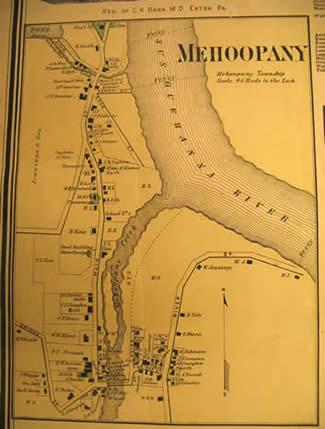
(4) The location of Emer's farm (7 miles above Mehoopany, PA) would have been 52 miles from Harmony (now Oakland), Pennsylvania. The route most likely went through Montrose and through the Lackawanda Valley across the Susquannah at Great Bend and over to Harmony. See map.
(5) Martin Harris worked as Joseph’s scribe from April to June of 1828 in Harmony, PA. During that time they completed 116 pages of manuscript.
(6) "Early Ontario Court Records," Lyons, New York, Deed Books B., p. 296 and D., p. 282, 1806, 1807.
(7) Franklin S. Harris, Sr., MSS 340, in Special Collections, Harold B. Lee Library, Brigham Young University, Provo, Utah; hereafter cited as "Writings of Emer Harris".) Also see: (JH 22 Dec 1832)
(8) "Family Record of Emer Harris," March 19, 1868, (in a family publication, Martin Henderson Harris A Utah Pioneer, July 21, 1952), p. 1; hereafter cited as M.H.H. See Link to pages of M.H.H.

(9) Luzerne County Deeds, 1787 - 1901, Book 27: pages 346–347, Luzerne County Courthouse Annex, Wilkes-Barre, Pennsylvania
Final payment was not made until 1827 and not officially recorded until 1830. See transcription of original agreement and subsequent entries.
(10 M.H.H., p. 1.
(11) Ibid. According to his Memorandum on pg. 12: Martin H. Harris was born 29 Sep 1820 in Windham Township, Luzern County , PA near the junction of little Mahoopany Creek with the Susquehanna River and lived there until about seven years old then moved on 16 Mar 1827seven miles up the Creek onto a new farm.
(12) Writings of Emer Harris.
(13) M.H.H., p. 1.
(14) This is Jenningsville, PA w hich is located 7+ miles up creek, from Mahoopany, PA
(15) If Emer visit Martin during this time the journey was less than 50 miles. See Map
(16) Franklin S. Harris, Sr., MSS 340, in Special Collections, Harold B. Lee Library, Brigham Young University, Provo, Utah
(17) M.H.H., Journal, addendum, Leander Harris
(18) Franklin S. Harris, Sr., MSS 340, in Special Collections, Harold B. Lee Library, Brigham Young University, Provo, Utah
(19) JD Vol.2 p. 213
(20) M.H.H., Journal
(21) http://www.joycetice.com/bradsby/canthcb.htm Excerpt from History of Bradford County, Pennsylvania with Biographical Sketches By H. C. Bradsby, 1891 CHAPTER 30. Canton Township & Canton Borough "In 1799, Isaac Chaapel, of Massachusetts, came and settled on the place near where is Chauncey Chaapel's house. Isaac was a prominent man, and was justice of the peace quite a long, time"
(22) See 1810 Transcribed Census http://www.joycetice.com/censusb/1810cant.htm (Canton Township is now in Bradford County)
(23) See 1800 Transcribed Census http://files.usgwarchives.org/pa/luzerne/census/1800/pg0192b.txt (Braintrim Township is now in Wyoming County)
(24) Windham Township is now in Wyoming County, PA. http://en.wikipedia.org/wiki/Windham_Township,_Wyoming_County,_Pennsylvania. Also See Map near Laceyville, PA Windham Township is south and Braintrim Township is across (north) of the Susquhanna River in the same area. See Map

(25) In 1791 Zephaniah Lott settled at the mouth of the Mehoophany creek, on the present Jennings estate. The first tavern was kept at Arnold's ferry as early as 1815, by Zephaniah Lott. The first saw-mill was also built by Zephaniah and Leonard Lott, on the site of the one now owned by Moses S. Kintner. W.W.Munsell & Co. History of Luzerne, Lackawanna, and Wyoming counties, Pa page 173 - 175
(26) Of the three sawmills in Mehoophany, one was built Zephaniah and Leonard Lott and another about a half a mile further up that stream about the same time. A third was built by Mr. Carney as early as 1800, on the property now owned by H. H. K. and J. French. The pioneer grist-mill was built in 1806, two or three rods above the site of the present mill on the Little Mehoopany, by William, Joseph and John Carney. This is the sawmill that Emer bought a 3/8th share. Ibid.
(27) "Newel Knight's Journal," Classic Experiences and Adventures (Salt Lake City: Bookcraft, 1969), pp. 46-104. Chapter 5
(28) This first edition Book of Mormon and a small black book of common prayer owned by Emer's father nathan bearing his signature is now in possesion of Deseret Book Co. in SLC, UT.
(29) Searching the 1800 census records of other Peas(e) families in the counties nearest Palmyra reveal no single females between the ages of 15-25 living in those households making it highly improbable that Roxana was a local girl. Perhaps she was from Easton, NY where several Pease families had moved during the same time Emer lived there as a youth. He origins continue to be a mystery. .
(30) Wyoming Co. Deeds Book 2:73, Jan. 1845, mentions a parcel being bound on the north by roswell Garey, east by S.S. Taylor, other lands of Cyrus Clapp, south on the town line and west on lands of Rufus and Herman S. Graves, being the same tract of land conveyed to Cyrus Clapp by Emor harris by indenture bearing the date of 6 July 1838 and containing about 140 acres.
(31) Luzerne Co. Deeds Book 26:414, 4 Jan. 1830, 150 acres in Windham Township purchased from County for $6.30 in back taxes. Note the description includes "Lot 42". See Warrantee map detail showing Lot 42 (owned at that time by Johathan Stevens) with 274 acres.
(32) Franklin S. Harris, Sr., MSS 340, in Special Collections, Harold B. Lee Library, Brigham Young University, Provo, Utah. Box 3fid.2 Actual handwritten Divorce Decree. In a letter from Leandor S. Harris to Franklin S. Harris, he states (speaking of Emer, his grandfather, and Roxanna, "I never knew what caused the estrangement between them. Your father and mine visited them (children of Roxanna) when on their missions. I corresponded with some of the children who were not very friendly to the church but they treated our fathers very kindly"
(33) Tax records list Emer Harris starting 1817. Windham Twp. was formed from Braintrim Twp between 1816-1817, the exact date is not found. There are no listed prior in the 1816 Braintrim Twp. tax records.
(34) Martin Henderson Harris, “Reminiscences and Journal, 1856–1876,” ms. 1781, p. 1, depository. Emer left his property interests in the town of Windham, Luzerne County, Pennsylvania, with an agreement for later compensation, see Emer Harris to George James or Parna Harris, 7 May 1833,
Information on Jenningsville: has been the site of farming and of numerous saw-mills since its earliest settlement and quite an extensive lumbering point. Jonathan Whitney had a saw-mill here or near by in 1805.
(35) In 1791, Vermont was admitted into the Union as a State, thus putting the seal of Federal authority on the border dispute and settlement arrived at this same year between Vermont and New York States. Washington county thus became permanently a border county along all of Vermont's enormous length. In this year also the counties of Rensselaer and Saratoga were formed from Albany. By the same act the town of Cambridge, comprising also the present towns of Jackson and White Creek, was transferred to Washington county, and that part of the towns of Saratoga and Stillwater lying east of the Hudson was formed into a new town, by the name of Easton, and also annexed to Washington County. Emer was born in Cambridge, but the family's residence then became part of the new town of Easton, explaining the claim by Emer that he was born in a Cambridge area which then became Easton. See explaination at: https://archive.org/stream/historyofwashing00john/historyofwashing00john_djvu.txt .
(36) Susquehanna Democrat Newspaper, 22 January 1819, "Married-At Windham, on the 16th inst., by Josiah Fasset, Emer Harris to Miss Deborah Lott"
(37) Susquehanna Democrat Newspaper, 4 December 1818, "Divorce-To Rocksanna Harris. Take Notice, that your husband, Emer Harris, has applied to the court of Common Pleas of Luzerne County, for a divorce from the bonds of matrimony. You are therefore hereby required to be and appear at the court of Common Pleas to be held at Wilkesbarre, in and for said county, on the first Monday of January next to answer the said complaint. Stephen Van Loon, Sheriff."
(38) 48. “Early Church Information File,” The Genealogical Society: Scraps of Biography, pp. 65–66.